5 Languages Whose Native Speakers Find English Most Difficult: Understanding Linguistic Distance
By Alfredo Nunes ·
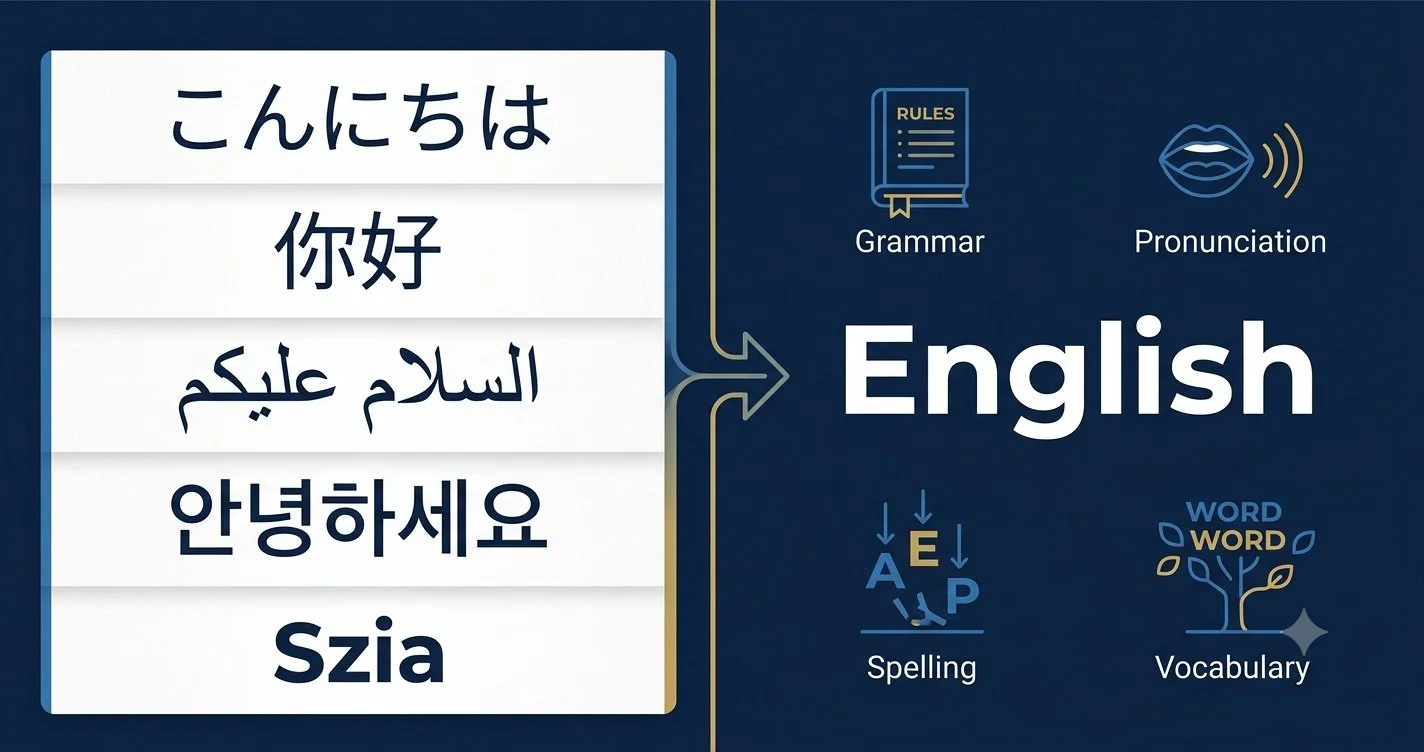
Why English Is So Difficult for Speakers of These 5 Languages (And How to Overcome It)
Meta Title: Top 5 Languages That Make Learning English Most Difficult (And Why)
Meta Description: Discover the five native languages whose speakers face the biggest challenges learning English. Learn why these difficulties occur and practical exercises to overcome them.
Why Some Languages Make English Much Harder to Learn
Learning English isn't equally difficult for everyone. If your native language already shares vocabulary, grammar, and sentence structure with English, you'll probably progress much faster.
But if your first language is fundamentally different, every aspect of English—from pronunciation and grammar to spelling and sentence structure—can feel completely foreign.
One useful way to understand this challenge is through linguistic distance—the degree to which two languages differ. The greater the distance, the more new concepts a learner must master.
The U.S. Foreign Service Institute (FSI) classifies Japanese, Mandarin Chinese, Arabic, and Korean among the most difficult languages for native English speakers to learn (Category V), highlighting just how different they are from English. That same linguistic distance creates significant obstacles when speakers of those languages learn English.
Let's explore the five language backgrounds that often face the steepest climb.
1. Japanese: The Boss Level
The Linguistic Conflict (The "Why")
Japanese and English operate almost like mirror images.
Japanese follows a Subject–Object–Verb structure:
I coffee drink.
English uses:
I drink coffee.
But word order is only the beginning.
Japanese is syllable-timed, while English is stress-timed, meaning English words rise and fall in rhythm. Articles ("a," "an," "the") don't exist in Japanese, and many consonant sounds—including the distinction between R and L—are absent.
Instead of learning new vocabulary, Japanese learners often feel they're learning an entirely new way of thinking.
The Worst Symptoms
Typical mistakes include:
- "I went store yesterday."
- "Rice is very delicious" (missing article)
- "Light" sounding like "right"
- "Glass" becoming "gurasu"
- Speaking every syllable with equal stress, making English sound robotic.
How to Overcome It
Instead of memorizing grammar rules first, train your ear.
Try these exercises:
- Shadow native speakers for 10 minutes daily.
- Practice minimal pairs:
- Light vs. Right
- Glass vs. Grass
- Road vs. Load
- Read children's books aloud while exaggerating English stress patterns.
- Learn articles as fixed chunks ("go to the store," "take a bus") rather than isolated rules.
2. Mandarin Chinese: When Every Rule Changes
The Linguistic Conflict (The "Why")
Mandarin presents one of the biggest jumps into English because almost every system changes.
Mandarin is:
- tonal
- character-based
- largely free from verb conjugations
- free from plural noun endings
- without articles
English introduces all of these simultaneously.
For Mandarin speakers, understanding that walk, walks, walked, and walking are all forms of the same verb can initially feel illogical.
English spelling adds another obstacle.
Words like:
- through
- though
- tough
- thought
share similar letters but sound completely different.
The Worst Symptoms
Common mistakes include:
- "Yesterday I go."
- "Three cat."
- Confusing ship and sheep
- Reading every word exactly as it's spelled
- Ignoring word stress
How to Overcome It
Focus on patterns instead of individual words.
Practice by:
- keeping a verb tense journal
- reading aloud while listening to native audio
- grouping words by pronunciation rather than spelling
- learning entire phrases instead of isolated vocabulary
Most importantly, stop expecting English spelling to be logical—it often isn't.
3. Arabic: The Vowel Maze
The Linguistic Conflict (The "Why")
Arabic differs dramatically from English.
It is:
- written right to left
- built around three-letter root systems
- much richer in consonant patterns than vowel distinctions
English, however, relies heavily on vowel sounds.
Words like:
- ship
- sheep
- sit
- seat
may sound almost identical to beginners, yet they completely change meaning.
Arabic also lacks the P sound in many dialects, making words like "park" and "bark" difficult to distinguish.
English prepositions create another major hurdle.
Learners frequently ask:
Why do we say:
- interested in
- good at
- depend on
instead of following consistent logic?
Because English often doesn't.
The Worst Symptoms
Common errors include:
- "Bark" instead of "Park"
- "I married with her."
- "Explain me."
- Confusing vowels such as live/leave or full/fool.
How to Overcome It
Practice minimal-pair drills every day.
Examples:
- Park / Bark
- Pin / Bin
- Pat / Bat
Record yourself reading aloud and compare your pronunciation with native audio.
For prepositions, memorize complete expressions instead of individual words.
For example:
- interested in
- depend on
- afraid of
- good at
Learning them as chunks dramatically improves fluency.
4. Korean: When English Feels Too Direct
The Linguistic Conflict (The "Why")
Korean grammar relies heavily on particles and honorifics rather than fixed word order.
English works differently.
Because English depends much more on word order, simply moving one word can change an entire sentence.
Korean speakers also encounter:
- unfamiliar articles
- verb tense differences
- difficult consonant clusters
- unpredictable pronunciation
Another challenge is that English often sounds surprisingly blunt compared with Korean's highly developed politeness system.
The Worst Symptoms
Frequent mistakes include:
- Omitting articles
- "Teacher gave homework me."
- Difficulty pronouncing words like:
- street
- spring
- strength
Many learners also hesitate in conversation because they're searching for the "correct" politeness level before speaking.
How to Overcome It
Practice speaking in sentence chunks.
Examples:
- Could you help me?
- Would you mind...?
- Can I ask...?
Then focus on consonant clusters:
- street
- splash
- spring
- strength
Read slowly, then gradually increase speed while maintaining accurate pronunciation.
5. Hungarian: A Different Way of Building Language
The Linguistic Conflict (The "Why")
Although Hungary sits in Europe, Hungarian is not an Indo-European language.
Instead, it's agglutinative, meaning grammatical information is attached to words using long chains of suffixes.
English usually expresses the same ideas using separate words.
Hungarian also allows relatively flexible word order, whereas English depends much more on position to convey meaning.
As a result, English often feels unnecessarily rigid.
The Worst Symptoms
Typical issues include:
- Missing articles
- Incorrect word order
- Confusing prepositions:
- in
- on
- at
- Translating directly from Hungarian sentence structure
How to Overcome It
Instead of translating mentally, learn complete English patterns.
Practice with:
- in the morning
- at night
- on Monday
- go to school
- come home
Flashcards built around phrases—not individual words—help learners think naturally in English instead of translating from Hungarian.
Why These Learners Can Still Become Fluent
Although these five language backgrounds face some of the biggest linguistic hurdles, difficulty does not determine success.
Millions of native speakers of Japanese, Mandarin, Arabic, Korean, and Hungarian have achieved near-native English fluency.
The difference isn't talent.
It's targeted practice.
When learners understand why they're making certain mistakes, they can focus on the specific habits that need changing instead of endlessly memorizing grammar rules.
Language learning becomes much faster when practice matches the problem.
Final Thoughts
English is challenging because it combines inconsistent spelling, complex pronunciation, irregular grammar, and countless exceptions.
For learners whose native language is already very different from English, those challenges multiply.
But linguistic distance is not destiny.
With deliberate practice—whether it's mastering English stress patterns, drilling difficult sounds, or learning phrases instead of isolated words—every obstacle becomes manageable.
The languages that make English hardest to learn simply require smarter strategies, not greater intelligence.