How to Speak English More Confidently: 10 Simple Habits for A2–B1 Learners
By Alfredo Nunes ·
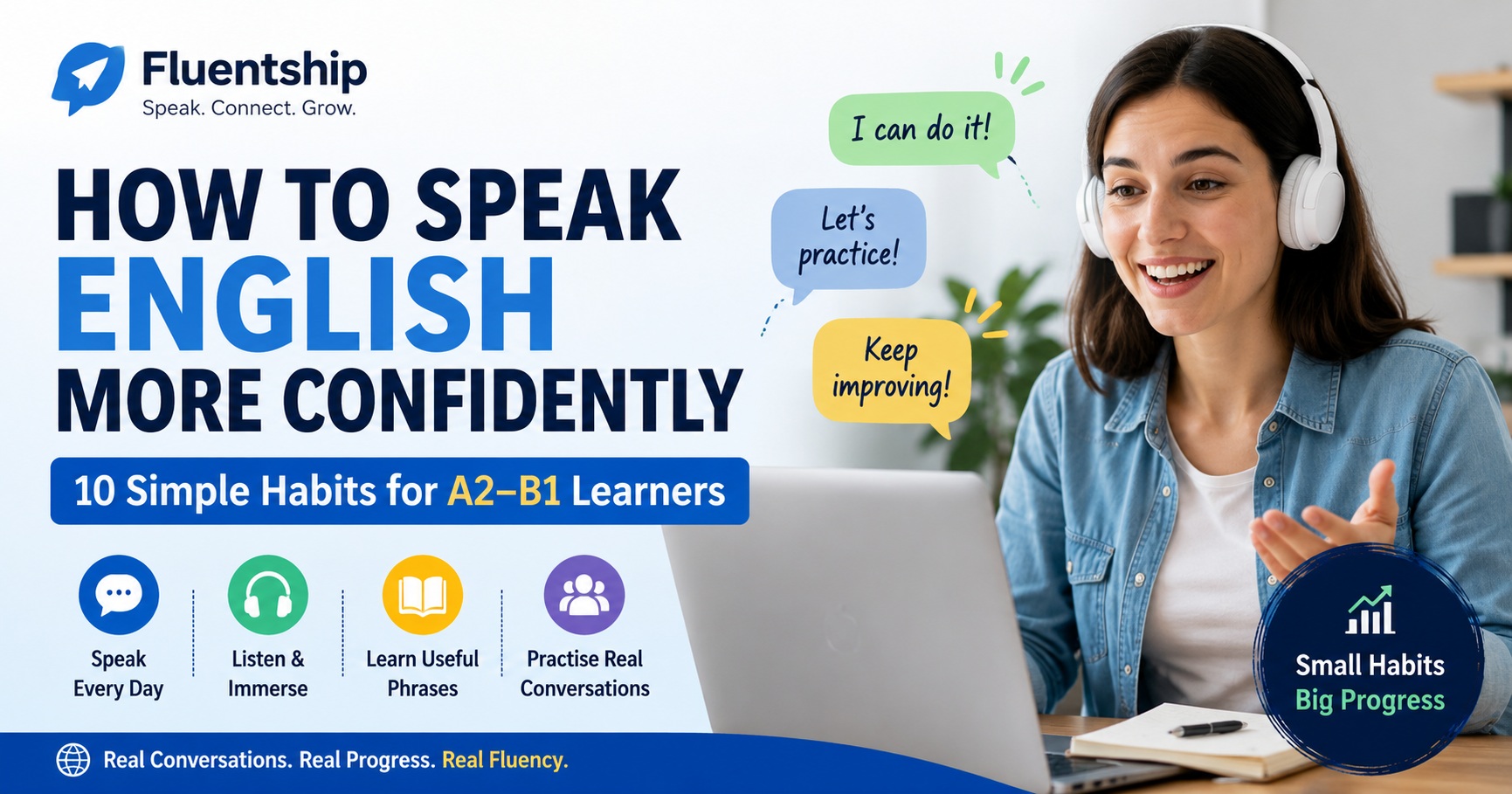
How to Speak English More Confidently: 10 Simple Habits for A2–B1 Learners
Do you understand quite a lot of English, but find it difficult to speak?
Perhaps you can read an English message and understand the main idea. You may know many English words and understand what someone says to you.
But when it is your turn to speak, you suddenly think:
“What should I say?”
This is very common for English learners at A2 and B1 level.
The good news is that you do not need perfect English to speak English confidently. You need regular practice, useful phrases and the confidence to make mistakes.
Here are 10 simple habits that can help you improve your English speaking skills every day.
1. Speak English Every Day
You do not need to speak English for two hours every day.
Even 10–15 minutes of speaking practice can be useful if you do it regularly.
Talk about simple things:
- What you did today
- What you are going to do tomorrow
- What you ate
- Your job or studies
- Your family
- Your hobbies
- A film or video you watched
For example:
“Today I went to work. It was quite busy. After work, I went to the supermarket because I needed some food.”
This may sound simple, but simple English is exactly what you need to practise.
Remember:
Short and regular practice is better than long and occasional practice.
2. Learn Phrases, Not Just Words
Knowing individual words is useful, but real conversations are built from phrases.
For example, you might know:
“agree”
But it is more useful to learn:
“I agree with you.”
Or instead of learning only:
“idea”
learn:
“That’s a good idea.”
Useful phrases give you something ready to use when you speak.
Try learning phrases such as:
- “I think that…”
- “In my opinion…”
- “I’m not sure, but…”
- “What do you mean?”
- “Could you say that again?”
- “That sounds interesting.”
- “I agree.”
- “I don’t agree.”
- “It depends.”
- “For example…”
These phrases are useful at both A2 and B1 English level.
3. Stop Trying to Translate Everything
At A2 level, it is normal to translate from your first language into English.
But if you translate every sentence before speaking, conversations can become slow and difficult.
Instead, try to think in small English ideas.
Imagine you want to say:
“I went to the restaurant with my friend because it was her birthday.”
You do not need to construct the whole sentence perfectly in your head.
Start with:
“Yesterday…”
“I went to a restaurant…”
“with my friend…”
“because it was her birthday.”
Build the sentence as you speak.
This becomes easier with practice.
4. Use the “Three-Sentence Rule”
Here is a simple English speaking exercise you can do anywhere.
Choose a topic and say three sentences about it.
Topic: Your weekend
“I had a busy weekend.
On Saturday, I met some friends.
On Sunday, I stayed at home and watched a film.”
That's it.
Now choose another topic:
Your favourite food.
“My favourite food is Italian food.
I really like pasta and pizza.
I usually eat it at the weekend.”
Three sentences may seem easy—but this exercise helps you practise speaking without preparing a long speech.
As your English improves, increase it to five or ten sentences.
5. Don't Be Afraid of Mistakes
One of the biggest barriers to English speaking is fear.
You may think:
“My grammar isn't perfect.”
Or:
“My pronunciation isn't very good.”
But making mistakes is part of learning a language.
Imagine a child learning to ride a bicycle. They fall down. They try again. They improve.
Speaking English works in a similar way.
You don't become confident and then start speaking. You start speaking, and confidence develops.
6. Learn How to Keep a Conversation Going
Being able to start a conversation is useful.
But being able to continue one is even more important.
Imagine someone asks:
“What did you do at the weekend?”
You could answer:
“I went shopping.”
Conversation finished.
Or you could say:
“I went shopping with my sister. We were looking for some clothes. What about you? What did you do?”
Now you have created another opportunity to speak.
Useful conversation questions include:
- “What about you?”
- “How about you?”
- “What do you think?”
- “Have you ever tried it?”
- “Why do you like it?”
- “When did you start?”
- “What happened next?”
These small questions can make a big difference to your English conversations.
7. Practise Saying the Same Thing in Different Ways
You don't always need new vocabulary.
Sometimes you need to become better at using the vocabulary you already know.
For example:
“I like London.”
Now try:
“I really like London.”
Then:
“I like living in London because there are so many things to do.”
Then:
“One of the things I like most about London is the variety of people and cultures.”
You are using the same basic idea, but making your English more detailed.
This is an excellent exercise for moving from A2 towards B1 English.
8. Listen to English Before You Speak It
Good speaking depends partly on good listening.
Listen to short pieces of English and notice:
- How words are pronounced
- Which words are stressed
- How sentences are connected
- Which phrases people use naturally
Then repeat what you hear.
This is sometimes called shadowing.
For example, listen to:
“What are you doing this weekend?”
Pause the audio.
Then say the sentence yourself.
Try to copy the rhythm and pronunciation—not just the individual words.
9. Make English Part of Your Everyday Life
You don't have to sit at a desk to learn English.
You can practise English while doing normal activities.
At breakfast
Describe what you are doing:
“I'm making coffee.”
On the way to work
Think about your plans:
“Today I'm going to have a meeting at ten.”
At the supermarket
Name what you see:
“I need to buy some bread and vegetables.”
Before going to bed
Think about your day:
“Today was quite busy, but I finished everything I needed to do.”
These small moments turn everyday life into English speaking practice.
10. Have Real Conversations
This may be the most important habit of all.
Apps, vocabulary exercises and grammar lessons can help you learn English.
But eventually, you need to use English to communicate with another person.
A real conversation forces you to:
- Listen
- Understand
- Think
- Respond
- Ask questions
- Explain yourself
- Deal with mistakes
And you cannot always predict what the other person will say.
That is exactly what makes conversation such powerful English practice.
A Simple 15-Minute English Speaking Routine
Don't know where to start?
Try this routine every day.
Minutes 1–3: Think
Choose one simple topic.
For example:
“What did I do yesterday?”
Think of three things you want to say.
Minutes 4–8: Speak
Talk about the topic aloud.
Don't stop every time you make a mistake.
Keep going.
Minutes 9–12: Improve
Think about one or two things you could say better.
Perhaps you need a new word or a better phrase.
Minutes 13–15: Speak Again
Talk about the same topic again.
This time, try to use the new words or phrases.
You may be surprised by how much better your second attempt sounds.
What Should an A2 English Learner Focus On?
At A2 level, concentrate on confidence and everyday communication.
You should practise topics such as:
- Family and friends
- Food and shopping
- Work and study
- Travel
- Daily routines
- Hobbies
- Home
- Weather
- Health and wellbeing
- Plans and preferences
Your goal is not to speak complicated English.
Your goal is to communicate simple ideas clearly.
What Should a B1 English Learner Focus On?
At B1 level, start going beyond simple descriptions.
Practise:
- Giving opinions
- Explaining reasons
- Telling stories
- Describing experiences
- Comparing things
- Discussing advantages and disadvantages
- Agreeing and disagreeing
- Asking follow-up questions
For example, an A2 learner might say:
“I like working from home.”
A B1 learner could develop the idea:
“I like working from home because I don't have to travel to the office. However, sometimes I miss talking to my colleagues.”
That ability to develop an idea is an important step towards greater English fluency.
How Can I Improve My English Speaking Skills?
Featured Answer
The best way to improve English speaking is to practise speaking regularly in real or realistic conversations. Combine speaking practice with listening, useful phrases, vocabulary in context and structured lessons. Don't wait until your English is perfect before speaking.
The most important word is regularly.
One conversation every few weeks is unlikely to transform your speaking.
Small amounts of speaking practice several times a week can be much more effective.
Your English Doesn't Have to Be Perfect
If you're learning English at A2 or B1 level, remember this:
You already know more English than you think.
You don't need 10,000 words before you can have a conversation.
You don't need perfect grammar.
You don't need a perfect accent.
You need to use the English you already have—and gradually build on it.
Every conversation gives you another opportunity to learn.
Every mistake gives you something to improve.
And every time you speak, you're one step closer to speaking with confidence.
Ready to Practise Your English?
Fluentship is built around a simple idea:
Start speaking a new language from your first lesson.
Whether you're learning English at A2, B1 or a higher level, structured lessons and real conversation can help turn knowledge into communication.
Explore Fluentship and find your next opportunity to practise English.
Keep Learning
If you're working towards better English fluency, you may also enjoy:
What Is Language Fluency? (And What It Really Means) — understand what fluency actually means and why perfect English isn't the goal.
Fluency vs Fluidity: Which One Actually Matters When Learning a Language? — explore the difference between knowing a language and being able to use it naturally.
What Is the Best Way to Learn Languages? (A Proven, Modern Approach for 2026) — discover how speaking, listening, structure and consistency work together.
Top Languages to Learn in 2026 (And Why They Matter More Than Ever) — explore which languages could be valuable to learn in today's increasingly connected world.